An interesting article about some deeps social reasons behind the American invasion of Iraq.
Brief summary: In the wake of the spectacular collapse of the Soviet Union, Americans (and perhaps most of the World) became convinced in the superiority of the American social and economic systems. The benefits of the globalization/international trade were obvious, as well as the fact that “[T]he hidden hand of the market will never work without a hidden fist,” - the hidden fist being the powerful and highly moral American military:
"Americans took it for granted that their own approach to democracy should and would apply universally. They believed themselves better positioned than any would-be competitor to capitalize on the promise of globalization. As for high-tech military power, Desert Storm had already testified to American prowess; what some were calling the Revolution in Military Affairs would translate a clear edge into permanent supremacy."
These beliefs were shared equally by the Democrats and the Republicans - for example, by Bill Clinton and his contemporary speaker of the House Newt Gingrich (this should not come as a surprise, if you have a good enough memory to remember the bi-partisan support for the Iraq invasion.)
9/11 came as a shock, which was quickly followed by denial in the form of an attempt to re-assert the American power. Saddam Husein was just a natural target:
"From this perspective, designating Saddam Hussein as Enemy No. 1 made a great deal of sense. Granted, Iraq was not involved in the terrorist attacks of Sept. 11. Hussein’s regime had only the most negligible links to al-Qaeda. And, of course, Iraq’s stockpile of nuclear and biological weapons turned out to be a figment of fevered imaginations. But critics who employed such facts to charge the Bush administration with deception or incompetence missed a larger point: The real aim of Operation Iraqi Freedom was to demonstrate that the United States still called the tune to which history marched. For such purposes, Hussein’s ramshackle regime presented an ideal target."
The rest is history. I suspect that the more the smoke clears, the clearer we will see that the reasons for the invasion of Iraq were deeper (although not necessarily more morally justifiable) than merely George Bush's animosity towards Saddam Hussein or the American lust for oil.
Showing posts with label oil price. Show all posts
Showing posts with label oil price. Show all posts
Sunday, December 18, 2011

Saturday, June 18, 2011
Oil prices and the Iraq war: disavowing the myth
The liberal media propagate an ungrounded belief that the increase in oil prices, that we have witnessed in the last decade, is a direct consequence of the American invasion of Iraq, and hence the President Bush's fault. While I always assumed that this is likely to be true, the discussion that I had yesterday with a friend of mine, made me reconsider this position.
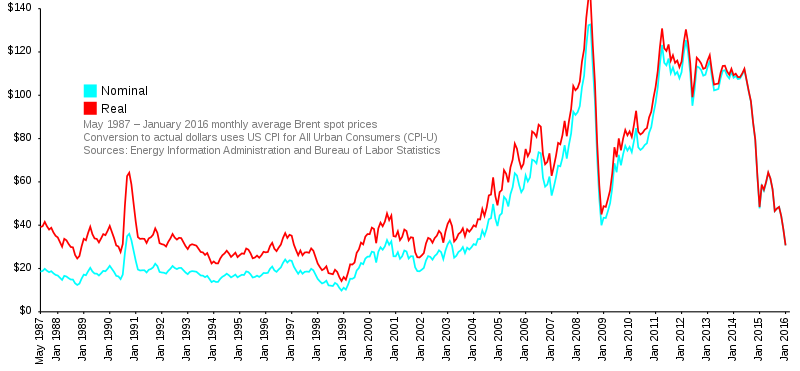
The correlation between the rise in oil prices and the Bush's presidency can be seen from the following graph:

http://upload.wikimedia.org/wikipedia/commons/thumb/0/0f/Brent_Spot_monthly.svg/800px-Brent_Spot_monthly.svg.png
The price of oils seems to be almost constant or even decreasing from 1987 (beginning of the graph) till Bush's presidency, when it steadily goes up. Hence, one concludes, the rise in oil prices is the consequence of George W. Bush's policies.
This point of view, however, does not hold the closer scrutiny, as we look more carefully at the dates and correlate them with the particular events:
Let's us keep in mind that the Bush's presidency occurred during 2001-2008
What we see in the graph is:
1. The overall rise in oil prices begins in 1999, during the Clinton's presidency, even before George W. Bush became his party's main candidate.
2. The oil prices begin to fall as the result of George Bush becoming the president and continue to fall till 2002, despite 9/11 events and the NATO invasion of Afghanistan during this period.
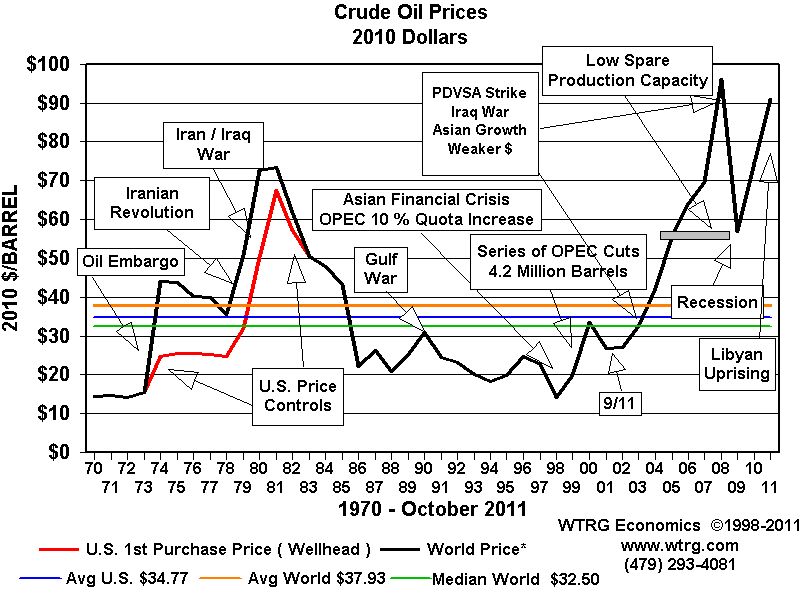
3. The next rise in prices begins in 2002, a year before the invasion of Iraq, and seems unaffected by the Iraq invasion. The latter can be seen from the median on the following graph:

http://www.oilworld.tk/wp-content/uploads/Oil-price-charts-1.jpg
If anything can be said about the correlation between the oil prices and the Iraq war, it is that the price growth was slowed by the US invasion in 2003, as well as after the killing of the anti-American leader Abu Musab al-Zarqawi and begging of the coordinated US-Iraqi counter-terrorist operation Operation Together Forward in the middle of 2006.
4. By taking a more generous timeline, we see that the current rise in the oil price is not unprecedented, and can be claimed to be "all time high" only if we discount the inflation.

http://2buygold.com/wp-content/uploads/2011/05/1306229445-32.gif
5. Finally, returning to the very first graph, we note that the significant fall in the oil prices in 2009, i.e. when Barack Obama became the president, was followed by even steeper increase, despite the American withdrawal from Iraq and the steps to appease the Arab World undertaken by the Obama administration.
Conclusions:
1. There is no obvious correlation between the oil prices and the war in Iraq - the oil price begins to rise steadily before the beginning of war and does not experience jumps as the results of the military actions. Thus, the rise in prices most likely determined by deeper reasons than George Bush's policies.
2. There are however obvious instances when the oil price growth was slowed as the result of the military action (beginning of war in 2003 and American successes in mid-2006.)
3. The rise of oil prices so far looks insensitive to the attempts of the Obama administration to annul George W. Bush policies by withdrawing from Iraq and engaging with the Arab World (i.e. the oil-producing countries).
The oil prices continue to rise.
Added later:
A possible objective reason for the oil price growth might be the fact that the consumption of oil has been growing faster than its production, as indicated here.
While Saudi Arabia has expressed its willingness to increase the oil production, out of fear that sharp increases in price may damage the market, the OPEC failed to achieve the corresponding agreement.
However, the data shown in these articles do not give a straightforward explanation for the steady growth of the oil price since 2002.
The correlation between the rise in oil prices and the Bush's presidency can be seen from the following graph:
http://upload.wikimedia.org/wikipedia/commons/thumb/0/0f/Brent_Spot_monthly.svg/800px-Brent_Spot_monthly.svg.png
The price of oils seems to be almost constant or even decreasing from 1987 (beginning of the graph) till Bush's presidency, when it steadily goes up. Hence, one concludes, the rise in oil prices is the consequence of George W. Bush's policies.
This point of view, however, does not hold the closer scrutiny, as we look more carefully at the dates and correlate them with the particular events:
Let's us keep in mind that the Bush's presidency occurred during 2001-2008
What we see in the graph is:
1. The overall rise in oil prices begins in 1999, during the Clinton's presidency, even before George W. Bush became his party's main candidate.
2. The oil prices begin to fall as the result of George Bush becoming the president and continue to fall till 2002, despite 9/11 events and the NATO invasion of Afghanistan during this period.
3. The next rise in prices begins in 2002, a year before the invasion of Iraq, and seems unaffected by the Iraq invasion. The latter can be seen from the median on the following graph:

http://www.oilworld.tk/wp-content/uploads/Oil-price-charts-1.jpg
If anything can be said about the correlation between the oil prices and the Iraq war, it is that the price growth was slowed by the US invasion in 2003, as well as after the killing of the anti-American leader Abu Musab al-Zarqawi and begging of the coordinated US-Iraqi counter-terrorist operation Operation Together Forward in the middle of 2006.
4. By taking a more generous timeline, we see that the current rise in the oil price is not unprecedented, and can be claimed to be "all time high" only if we discount the inflation.

http://2buygold.com/wp-content/uploads/2011/05/1306229445-32.gif
5. Finally, returning to the very first graph, we note that the significant fall in the oil prices in 2009, i.e. when Barack Obama became the president, was followed by even steeper increase, despite the American withdrawal from Iraq and the steps to appease the Arab World undertaken by the Obama administration.
Conclusions:
1. There is no obvious correlation between the oil prices and the war in Iraq - the oil price begins to rise steadily before the beginning of war and does not experience jumps as the results of the military actions. Thus, the rise in prices most likely determined by deeper reasons than George Bush's policies.
2. There are however obvious instances when the oil price growth was slowed as the result of the military action (beginning of war in 2003 and American successes in mid-2006.)
3. The rise of oil prices so far looks insensitive to the attempts of the Obama administration to annul George W. Bush policies by withdrawing from Iraq and engaging with the Arab World (i.e. the oil-producing countries).
The oil prices continue to rise.
Added later:
A possible objective reason for the oil price growth might be the fact that the consumption of oil has been growing faster than its production, as indicated here.
While Saudi Arabia has expressed its willingness to increase the oil production, out of fear that sharp increases in price may damage the market, the OPEC failed to achieve the corresponding agreement.
However, the data shown in these articles do not give a straightforward explanation for the steady growth of the oil price since 2002.
Subscribe to:
Posts (Atom)