Here is an article by Senator Joe Lieberman, making a case for US intervention in Syria:
"What is happening in Syria is a humanitarian catastrophe, with at least
10,000 dead, more than 1 million people displaced and horrific human
rights abuses perpetrated daily, including the widespread and deliberate
use of rape and other sexual violence as weapons of war."
Predictably, many of the comments following the article accuse Lieberman of war-mongering and being a "neo-con". As I show below, there is no perfectly moral way to take a position in regard to a war, but there is one way that is clearly wrong: making one's position fit the one's biases or political preferences.
One may oppose any war and all violence. This is a highly principled, although a somewhat naive position. On the surface it also looks like a highly moral one. Yet, the morality of confronting violence with inaction is questionable, as is illustrated by the famous poem "First they came...".
One may adopt the "responsibility to protect" attitude, and always take the side of victims against the oppressors. This is a principled position as well, which perhaps culminated in the George W. Bush's "Freedom agenda". The problem is with deciding who is a victim and who is the oppressor, since one can easily transform into the other. In addition, killing in the name of protecting someone is still killing. Oppressors are no less human their victims.
One may adopt a "realistic" view and support a war when one may benefit from it economically, politically or in terms of one's own safety, while opposing it when no benefit is forthcoming. This is a cynical and cruel attitude, but it is a consistent position... and perhaps the only one that a national leader should adopt.
The attitude that one shouldn't adopt is the hypocritical one: such as supporting the military action initiated by a Democratic President, while opposing the "Republican" wars; or supporting the "resistance" by Hamas/Hezbollah, while opposing Israel's self-defense measures.
Unfortunately, the fact that the events in Syria are largely overlooked,
while much smaller scale events in other places, for example in
Israel, trigger worldwide protests, is a testimony to the widespread
hypocricy. The same can be said about those who passionately oppose the wars in Afghanistan and Iraq, while cheering the "real leadership" that President Obama has shown in ordering the raid against Osama bin Laden, in "leading from behind" the "humanitarian" strikes in Libya, and in waging the "smart war" using unmanned aerial vehicles in Pakistan and Yemen, which has taken thousands of lives.
Showing posts with label war. Show all posts
Showing posts with label war. Show all posts
Friday, May 18, 2012

Sunday, January 29, 2012
Dating, War and Dr. Strangelove
I discussed recently dating from the point of view of market strategy, and also pointed out the link, where the game theory was applied to the same model. These things are more than a joke: once upon a time the game theory was deciding the fate of the World: it was behind the American (and perhaps also Soviet) strategy during the Cold War era.
This article discusses how game theory led to the Cold War episode, known as "Operation Gian Lance":
"Nixon's madman pose and Giant Lance were based on game theory, a branch of mathematics that uses simple calculations and rigorous logic to help understand how people make choices — like whether to surge ahead in traffic or whether to respond to a military provocation with a strike of one's own. The most famous example in the field is the Prisoner's Dilemma: If two criminal suspects are held in separate cells, should they keep mum or rat each other out? (Answer: They should keep quiet, but as self-interested actors, what they will do is betray each other and both go to jail.) In the Cold War, the "games" were much more complicated simulations of war and bargaining: Would the Soviets be more likely to attack Western Europe if we kept missiles there or if we didn't?
Kissinger had studied game theory as a young academic and strategic theorist at Harvard. In the early '60s, he was part of a group of World War II veterans who became the oracles or "whiz kids" of the nuclear age. Working at newly formed institutes and think tanks, like the RAND Corporation, they preached that the proper way to deal with the existence of nuclear weapons wasn't to act as if the situation was so grave that one couldn't even discuss using them; it was to figure out how to use them most effectively. This was the attitude mocked by Stanley Kubrik in Dr. Strangelove, in which RAND appears thinly disguised as the Bland Corporation."
This article discusses how game theory led to the Cold War episode, known as "Operation Gian Lance":
"Nixon's madman pose and Giant Lance were based on game theory, a branch of mathematics that uses simple calculations and rigorous logic to help understand how people make choices — like whether to surge ahead in traffic or whether to respond to a military provocation with a strike of one's own. The most famous example in the field is the Prisoner's Dilemma: If two criminal suspects are held in separate cells, should they keep mum or rat each other out? (Answer: They should keep quiet, but as self-interested actors, what they will do is betray each other and both go to jail.) In the Cold War, the "games" were much more complicated simulations of war and bargaining: Would the Soviets be more likely to attack Western Europe if we kept missiles there or if we didn't?
Kissinger had studied game theory as a young academic and strategic theorist at Harvard. In the early '60s, he was part of a group of World War II veterans who became the oracles or "whiz kids" of the nuclear age. Working at newly formed institutes and think tanks, like the RAND Corporation, they preached that the proper way to deal with the existence of nuclear weapons wasn't to act as if the situation was so grave that one couldn't even discuss using them; it was to figure out how to use them most effectively. This was the attitude mocked by Stanley Kubrik in Dr. Strangelove, in which RAND appears thinly disguised as the Bland Corporation."
Saturday, June 18, 2011
Oil prices and the Iraq war: disavowing the myth
The liberal media propagate an ungrounded belief that the increase in oil prices, that we have witnessed in the last decade, is a direct consequence of the American invasion of Iraq, and hence the President Bush's fault. While I always assumed that this is likely to be true, the discussion that I had yesterday with a friend of mine, made me reconsider this position.
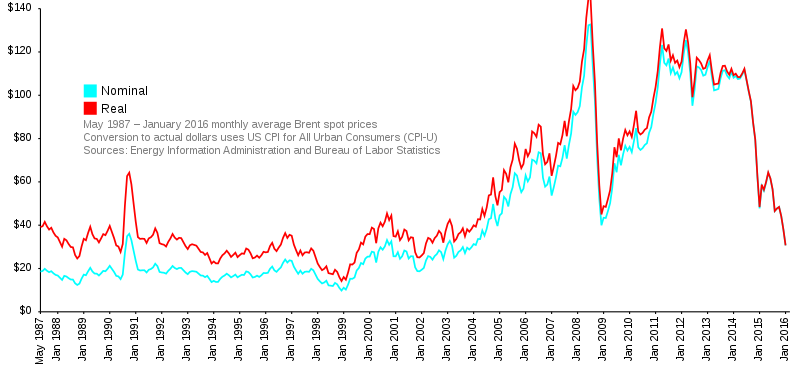
The correlation between the rise in oil prices and the Bush's presidency can be seen from the following graph:

http://upload.wikimedia.org/wikipedia/commons/thumb/0/0f/Brent_Spot_monthly.svg/800px-Brent_Spot_monthly.svg.png
The price of oils seems to be almost constant or even decreasing from 1987 (beginning of the graph) till Bush's presidency, when it steadily goes up. Hence, one concludes, the rise in oil prices is the consequence of George W. Bush's policies.
This point of view, however, does not hold the closer scrutiny, as we look more carefully at the dates and correlate them with the particular events:
Let's us keep in mind that the Bush's presidency occurred during 2001-2008
What we see in the graph is:
1. The overall rise in oil prices begins in 1999, during the Clinton's presidency, even before George W. Bush became his party's main candidate.
2. The oil prices begin to fall as the result of George Bush becoming the president and continue to fall till 2002, despite 9/11 events and the NATO invasion of Afghanistan during this period.
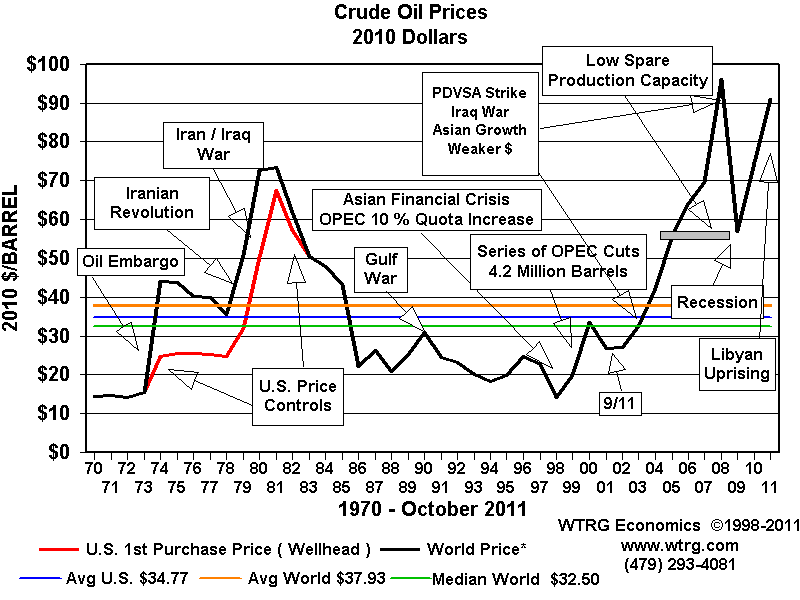
3. The next rise in prices begins in 2002, a year before the invasion of Iraq, and seems unaffected by the Iraq invasion. The latter can be seen from the median on the following graph:

http://www.oilworld.tk/wp-content/uploads/Oil-price-charts-1.jpg
If anything can be said about the correlation between the oil prices and the Iraq war, it is that the price growth was slowed by the US invasion in 2003, as well as after the killing of the anti-American leader Abu Musab al-Zarqawi and begging of the coordinated US-Iraqi counter-terrorist operation Operation Together Forward in the middle of 2006.
4. By taking a more generous timeline, we see that the current rise in the oil price is not unprecedented, and can be claimed to be "all time high" only if we discount the inflation.

http://2buygold.com/wp-content/uploads/2011/05/1306229445-32.gif
5. Finally, returning to the very first graph, we note that the significant fall in the oil prices in 2009, i.e. when Barack Obama became the president, was followed by even steeper increase, despite the American withdrawal from Iraq and the steps to appease the Arab World undertaken by the Obama administration.
Conclusions:
1. There is no obvious correlation between the oil prices and the war in Iraq - the oil price begins to rise steadily before the beginning of war and does not experience jumps as the results of the military actions. Thus, the rise in prices most likely determined by deeper reasons than George Bush's policies.
2. There are however obvious instances when the oil price growth was slowed as the result of the military action (beginning of war in 2003 and American successes in mid-2006.)
3. The rise of oil prices so far looks insensitive to the attempts of the Obama administration to annul George W. Bush policies by withdrawing from Iraq and engaging with the Arab World (i.e. the oil-producing countries).
The oil prices continue to rise.
Added later:
A possible objective reason for the oil price growth might be the fact that the consumption of oil has been growing faster than its production, as indicated here.
While Saudi Arabia has expressed its willingness to increase the oil production, out of fear that sharp increases in price may damage the market, the OPEC failed to achieve the corresponding agreement.
However, the data shown in these articles do not give a straightforward explanation for the steady growth of the oil price since 2002.
The correlation between the rise in oil prices and the Bush's presidency can be seen from the following graph:
http://upload.wikimedia.org/wikipedia/commons/thumb/0/0f/Brent_Spot_monthly.svg/800px-Brent_Spot_monthly.svg.png
The price of oils seems to be almost constant or even decreasing from 1987 (beginning of the graph) till Bush's presidency, when it steadily goes up. Hence, one concludes, the rise in oil prices is the consequence of George W. Bush's policies.
This point of view, however, does not hold the closer scrutiny, as we look more carefully at the dates and correlate them with the particular events:
Let's us keep in mind that the Bush's presidency occurred during 2001-2008
What we see in the graph is:
1. The overall rise in oil prices begins in 1999, during the Clinton's presidency, even before George W. Bush became his party's main candidate.
2. The oil prices begin to fall as the result of George Bush becoming the president and continue to fall till 2002, despite 9/11 events and the NATO invasion of Afghanistan during this period.
3. The next rise in prices begins in 2002, a year before the invasion of Iraq, and seems unaffected by the Iraq invasion. The latter can be seen from the median on the following graph:

http://www.oilworld.tk/wp-content/uploads/Oil-price-charts-1.jpg
If anything can be said about the correlation between the oil prices and the Iraq war, it is that the price growth was slowed by the US invasion in 2003, as well as after the killing of the anti-American leader Abu Musab al-Zarqawi and begging of the coordinated US-Iraqi counter-terrorist operation Operation Together Forward in the middle of 2006.
4. By taking a more generous timeline, we see that the current rise in the oil price is not unprecedented, and can be claimed to be "all time high" only if we discount the inflation.

http://2buygold.com/wp-content/uploads/2011/05/1306229445-32.gif
5. Finally, returning to the very first graph, we note that the significant fall in the oil prices in 2009, i.e. when Barack Obama became the president, was followed by even steeper increase, despite the American withdrawal from Iraq and the steps to appease the Arab World undertaken by the Obama administration.
Conclusions:
1. There is no obvious correlation between the oil prices and the war in Iraq - the oil price begins to rise steadily before the beginning of war and does not experience jumps as the results of the military actions. Thus, the rise in prices most likely determined by deeper reasons than George Bush's policies.
2. There are however obvious instances when the oil price growth was slowed as the result of the military action (beginning of war in 2003 and American successes in mid-2006.)
3. The rise of oil prices so far looks insensitive to the attempts of the Obama administration to annul George W. Bush policies by withdrawing from Iraq and engaging with the Arab World (i.e. the oil-producing countries).
The oil prices continue to rise.
Added later:
A possible objective reason for the oil price growth might be the fact that the consumption of oil has been growing faster than its production, as indicated here.
While Saudi Arabia has expressed its willingness to increase the oil production, out of fear that sharp increases in price may damage the market, the OPEC failed to achieve the corresponding agreement.
However, the data shown in these articles do not give a straightforward explanation for the steady growth of the oil price since 2002.
Subscribe to:
Comments (Atom)