This article in Haaretz (authored by Yossi Sarid) comes with the following statement: "The right wing has been in power for 35 years, with short intervals, but the left keeps running our lives from its fortified strongholds - the justice system, the media, academia."
Rational point of view:
Perhaps, there is too much of a scientist in me, but this made me laugh no less that the recent article about the "anti-witchcraft unit" in the Saudi Arabia. Indeed, how do you define left and right? The physically reasonable way is to cut the thing in the middle (center), which in politics would mean cutting between the two major parties, in the case of Israel between Likud (right) and Kadima (left). All the other movements than can be ranked according to their distance from the center.
If we adopt such a definition, it is easy to see that, contrary to the statement quoted above, left-wing governments spent significant time in power in the last 35 years.
Radical point of view:
It is unfortunately more often than not that people use a different definition of right and left: rather than compare their position to the existing spectrum of the opinions, they make an assumption that their position is the balanced one, and classify all other points of view in respect to theirs. Although this is a legitimate procedure, it naturally produces very subjective results, which look absurd in the eyes of the majority. In particular, a person, who objectively belongs to the extremely left part of a political spectrum, will see everyone else as right-wing and consequently come up with a ridiculous statement, which provoked this post.
The moment of truth comes when an intelligent person finds that majority of people hold the views that are significantly to the right (or left) of his/hers. In this case a liberal person adjusts his/her position or at least accepts that his/her views are rather extreme. However, more often people choose to insist that their views are the only correct ones, and try to force these views on everybody else. This has nothing to do with being liberal, but rather reflects communist/fascist tendencies. (Note: I use here the terms "communist" and "fascist" in general sense - as the terms for non-liberal/intolerant ideologies in the left and right respectively.)
Thursday, July 21, 2011

Sunday, July 17, 2011
"Tent city" protests in Tel Aviv
There is an ongoing protest in Tel Aviv about the housing prices.
Here are my comments:
1. The protest demonstrates the ignorance of the most protesters, as well as of the politicians involved, about the mechanisms behind the market economy. While the government may restrict the prices, this will likely result in the reduced offer on the housing market, i.e. in the shortage of the available housing.
2. In the case of the politicians supporting the protesters this ignorance is most likely deliberate. Particularly, particularly, this seems to be the case in regard to the members of the Meretz and Hadash party, who hold advanced University degrees. Given that they are among the smallest parties, their bet is a) either to bring down the government in a hope that the next government will be formed by Kadima which will allow Meretz and Hadash to become part of the ruling coalition, or b) playing to the feelings the most extreme/uncompromising of their supporters to ensure the party's re-election (at the moment Hadash and Meretz hold respectively 4 and 3 seats in 120-member Knesset.)
3. It is ironic that protests expand from Tel Aviv to Ben-Gurion University in Beer Sheva, since the housing in Beer Sheva is known to be quite cheap. This may be an indication of the fact that the protests reflect the political aspirations of the student union leaders, rather than those of the students themselves.
4. The support from the Spain's M15 movement is also not something that the protesters should be proud of. Indeed, the protests in Spain were triggered by the government attempts to introduce austerity measures in order to prevent a Greece-like economical crisis. It is also worth remembering that economically unjustified availability of the housing is believed to be the reason for the recent World economic recession.
Added:
Here is a relevant reference to a basic economics textbook:
Gregory Mankiw, "The Principles of Economics". In particular in Chapter 6: "Supply, Demand and government policies", there is a relevant example on p.125: "Rent control in New York City".
Here are my comments:
1. The protest demonstrates the ignorance of the most protesters, as well as of the politicians involved, about the mechanisms behind the market economy. While the government may restrict the prices, this will likely result in the reduced offer on the housing market, i.e. in the shortage of the available housing.
2. In the case of the politicians supporting the protesters this ignorance is most likely deliberate. Particularly, particularly, this seems to be the case in regard to the members of the Meretz and Hadash party, who hold advanced University degrees. Given that they are among the smallest parties, their bet is a) either to bring down the government in a hope that the next government will be formed by Kadima which will allow Meretz and Hadash to become part of the ruling coalition, or b) playing to the feelings the most extreme/uncompromising of their supporters to ensure the party's re-election (at the moment Hadash and Meretz hold respectively 4 and 3 seats in 120-member Knesset.)
3. It is ironic that protests expand from Tel Aviv to Ben-Gurion University in Beer Sheva, since the housing in Beer Sheva is known to be quite cheap. This may be an indication of the fact that the protests reflect the political aspirations of the student union leaders, rather than those of the students themselves.
4. The support from the Spain's M15 movement is also not something that the protesters should be proud of. Indeed, the protests in Spain were triggered by the government attempts to introduce austerity measures in order to prevent a Greece-like economical crisis. It is also worth remembering that economically unjustified availability of the housing is believed to be the reason for the recent World economic recession.
Added:
Here is a relevant reference to a basic economics textbook:
Gregory Mankiw, "The Principles of Economics". In particular in Chapter 6: "Supply, Demand and government policies", there is a relevant example on p.125: "Rent control in New York City".
Tuesday, July 12, 2011
Forgotten Freud
Wall Street Journal comes with this article on the dream-interpretation: http://online.wsj.com/article/SB10001424052702303678704576439831114438292.html?mod=WSJEUROPE_hpp_editorsPicks_2
I agree that the dream-interpretation is an interesting subject. However, I am astonished that the article neglects the pioneers of this field, first of which is, of course, Sigmund Freud. Indeed, the article goes only as far as to say "With imagery and symbolism, dreams can reveal important insights that we might not consciously notice otherwise, experts say. Dreams are "a different mode of thought," says Deirdre Barrett, a psychologist, professor at Harvard Medical School and author of the book "The Committee of Sleep." "
But the article really does not go further than discussing what is contained in his "The Interpretation of Dreams" or "The Introductory Lectures to Psychoanalysis" (Which are a very easy and interesting to read books as well.)
It is sad that more than a hundred years after Freud's discoveries, and after the sexual revolution, the mankind still denies this scientist the credit for opening a new field and getting many things correct.
I agree that the dream-interpretation is an interesting subject. However, I am astonished that the article neglects the pioneers of this field, first of which is, of course, Sigmund Freud. Indeed, the article goes only as far as to say "With imagery and symbolism, dreams can reveal important insights that we might not consciously notice otherwise, experts say. Dreams are "a different mode of thought," says Deirdre Barrett, a psychologist, professor at Harvard Medical School and author of the book "The Committee of Sleep." "
But the article really does not go further than discussing what is contained in his "The Interpretation of Dreams" or "The Introductory Lectures to Psychoanalysis" (Which are a very easy and interesting to read books as well.)
It is sad that more than a hundred years after Freud's discoveries, and after the sexual revolution, the mankind still denies this scientist the credit for opening a new field and getting many things correct.
Friday, July 8, 2011
"Right of free movement" or privilege to enter a country without visa
Here is the recent news about "flightilla", i.e. the plan by several hundreds of pro-Palestinian activists (mainly Europeans and Americans, i.e. holding European and American passports, allowing them visa-free entry to Israel) to arrive simultaneously to the Israel's Ben-Gurion Airport and hold there a protest.
I have already written elsewhere about the common misconception among the Western "liberals", who do not realize that their well-being and the very ability to hold and practice their liberal views are guaranteed by their governments imposing restrictions on access by non-Westerners. This misconception is on full display in relation to the "flightilla" - as one American activists said:
“I have been using my name, because I do not have anything to hide. I am hoping that my right to free movement will be allowed by all the countries through which I am traveling,”[Emphasis mine]
This person, obviously accustomed to freely traveling with her American passport, appears to be ignorant of the fact that any country has a right to deny access to unwelcome individuals. And this right supersedes these individuals right to free movement (whatever it means). Indeed, this activist's own country, the United States, exercises this right in respect to many foreign nationals by requiring them to obtain visas before visiting the US and often refusing to grant the requested visas. Indeed, had the Palestinians decided to arrive "en mass" to a US airport, this attempt would be countered in the very root by the US embassy.
Moreover, the ignorance about the US denying (rightfully) access to may foreigners becomes even more striking when we think about the millions of illegal immigrants living in the US, and the ongoing national debate on this issue, and the possibility of the immigration reform. In the World where the "right to free movement" were supreme, the illegal immigrants would not exist.
Finally, I would like to stress that, although I use the US as an example, all countries concerned about the well-being of their citizens practice similar harsh measures. There is no "right of free" movement between the countries - but there is a privilege to enter a country without visa.
I have already written elsewhere about the common misconception among the Western "liberals", who do not realize that their well-being and the very ability to hold and practice their liberal views are guaranteed by their governments imposing restrictions on access by non-Westerners. This misconception is on full display in relation to the "flightilla" - as one American activists said:
“I have been using my name, because I do not have anything to hide. I am hoping that my right to free movement will be allowed by all the countries through which I am traveling,”[Emphasis mine]
This person, obviously accustomed to freely traveling with her American passport, appears to be ignorant of the fact that any country has a right to deny access to unwelcome individuals. And this right supersedes these individuals right to free movement (whatever it means). Indeed, this activist's own country, the United States, exercises this right in respect to many foreign nationals by requiring them to obtain visas before visiting the US and often refusing to grant the requested visas. Indeed, had the Palestinians decided to arrive "en mass" to a US airport, this attempt would be countered in the very root by the US embassy.
Moreover, the ignorance about the US denying (rightfully) access to may foreigners becomes even more striking when we think about the millions of illegal immigrants living in the US, and the ongoing national debate on this issue, and the possibility of the immigration reform. In the World where the "right to free movement" were supreme, the illegal immigrants would not exist.
Finally, I would like to stress that, although I use the US as an example, all countries concerned about the well-being of their citizens practice similar harsh measures. There is no "right of free" movement between the countries - but there is a privilege to enter a country without visa.
Saturday, June 18, 2011
Oil prices and the Iraq war: disavowing the myth
The liberal media propagate an ungrounded belief that the increase in oil prices, that we have witnessed in the last decade, is a direct consequence of the American invasion of Iraq, and hence the President Bush's fault. While I always assumed that this is likely to be true, the discussion that I had yesterday with a friend of mine, made me reconsider this position.
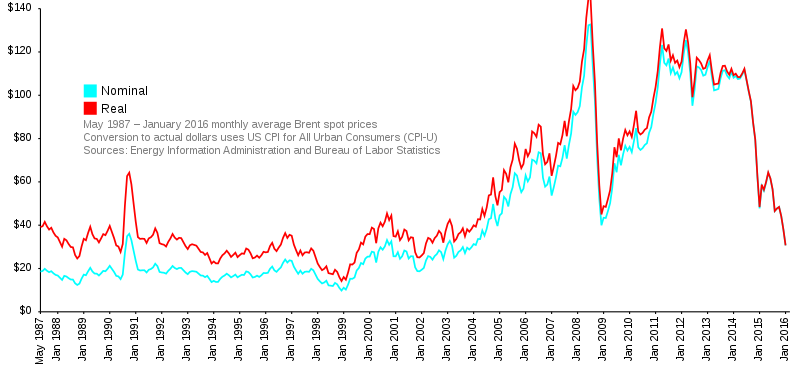
The correlation between the rise in oil prices and the Bush's presidency can be seen from the following graph:

http://upload.wikimedia.org/wikipedia/commons/thumb/0/0f/Brent_Spot_monthly.svg/800px-Brent_Spot_monthly.svg.png
The price of oils seems to be almost constant or even decreasing from 1987 (beginning of the graph) till Bush's presidency, when it steadily goes up. Hence, one concludes, the rise in oil prices is the consequence of George W. Bush's policies.
This point of view, however, does not hold the closer scrutiny, as we look more carefully at the dates and correlate them with the particular events:
Let's us keep in mind that the Bush's presidency occurred during 2001-2008
What we see in the graph is:
1. The overall rise in oil prices begins in 1999, during the Clinton's presidency, even before George W. Bush became his party's main candidate.
2. The oil prices begin to fall as the result of George Bush becoming the president and continue to fall till 2002, despite 9/11 events and the NATO invasion of Afghanistan during this period.
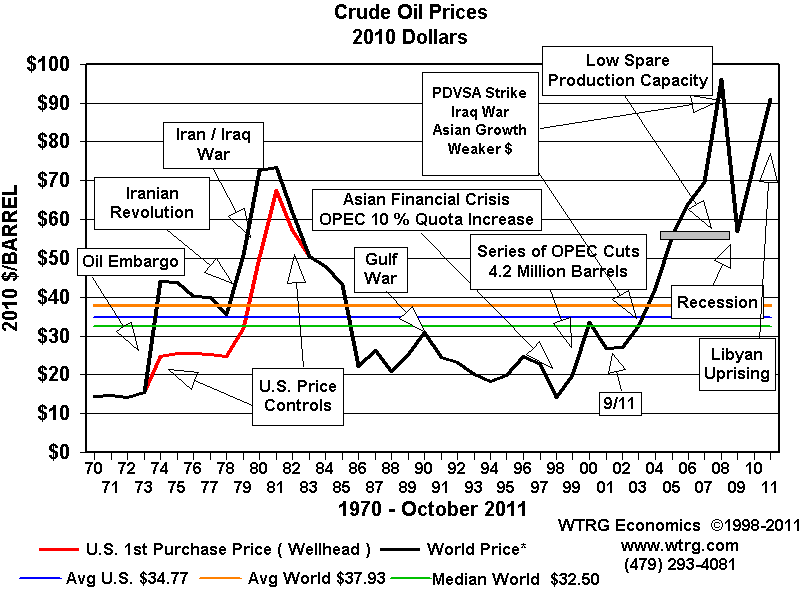
3. The next rise in prices begins in 2002, a year before the invasion of Iraq, and seems unaffected by the Iraq invasion. The latter can be seen from the median on the following graph:

http://www.oilworld.tk/wp-content/uploads/Oil-price-charts-1.jpg
If anything can be said about the correlation between the oil prices and the Iraq war, it is that the price growth was slowed by the US invasion in 2003, as well as after the killing of the anti-American leader Abu Musab al-Zarqawi and begging of the coordinated US-Iraqi counter-terrorist operation Operation Together Forward in the middle of 2006.
4. By taking a more generous timeline, we see that the current rise in the oil price is not unprecedented, and can be claimed to be "all time high" only if we discount the inflation.

http://2buygold.com/wp-content/uploads/2011/05/1306229445-32.gif
5. Finally, returning to the very first graph, we note that the significant fall in the oil prices in 2009, i.e. when Barack Obama became the president, was followed by even steeper increase, despite the American withdrawal from Iraq and the steps to appease the Arab World undertaken by the Obama administration.
Conclusions:
1. There is no obvious correlation between the oil prices and the war in Iraq - the oil price begins to rise steadily before the beginning of war and does not experience jumps as the results of the military actions. Thus, the rise in prices most likely determined by deeper reasons than George Bush's policies.
2. There are however obvious instances when the oil price growth was slowed as the result of the military action (beginning of war in 2003 and American successes in mid-2006.)
3. The rise of oil prices so far looks insensitive to the attempts of the Obama administration to annul George W. Bush policies by withdrawing from Iraq and engaging with the Arab World (i.e. the oil-producing countries).
The oil prices continue to rise.
Added later:
A possible objective reason for the oil price growth might be the fact that the consumption of oil has been growing faster than its production, as indicated here.
While Saudi Arabia has expressed its willingness to increase the oil production, out of fear that sharp increases in price may damage the market, the OPEC failed to achieve the corresponding agreement.
However, the data shown in these articles do not give a straightforward explanation for the steady growth of the oil price since 2002.
The correlation between the rise in oil prices and the Bush's presidency can be seen from the following graph:
http://upload.wikimedia.org/wikipedia/commons/thumb/0/0f/Brent_Spot_monthly.svg/800px-Brent_Spot_monthly.svg.png
The price of oils seems to be almost constant or even decreasing from 1987 (beginning of the graph) till Bush's presidency, when it steadily goes up. Hence, one concludes, the rise in oil prices is the consequence of George W. Bush's policies.
This point of view, however, does not hold the closer scrutiny, as we look more carefully at the dates and correlate them with the particular events:
Let's us keep in mind that the Bush's presidency occurred during 2001-2008
What we see in the graph is:
1. The overall rise in oil prices begins in 1999, during the Clinton's presidency, even before George W. Bush became his party's main candidate.
2. The oil prices begin to fall as the result of George Bush becoming the president and continue to fall till 2002, despite 9/11 events and the NATO invasion of Afghanistan during this period.
3. The next rise in prices begins in 2002, a year before the invasion of Iraq, and seems unaffected by the Iraq invasion. The latter can be seen from the median on the following graph:

http://www.oilworld.tk/wp-content/uploads/Oil-price-charts-1.jpg
If anything can be said about the correlation between the oil prices and the Iraq war, it is that the price growth was slowed by the US invasion in 2003, as well as after the killing of the anti-American leader Abu Musab al-Zarqawi and begging of the coordinated US-Iraqi counter-terrorist operation Operation Together Forward in the middle of 2006.
4. By taking a more generous timeline, we see that the current rise in the oil price is not unprecedented, and can be claimed to be "all time high" only if we discount the inflation.

http://2buygold.com/wp-content/uploads/2011/05/1306229445-32.gif
5. Finally, returning to the very first graph, we note that the significant fall in the oil prices in 2009, i.e. when Barack Obama became the president, was followed by even steeper increase, despite the American withdrawal from Iraq and the steps to appease the Arab World undertaken by the Obama administration.
Conclusions:
1. There is no obvious correlation between the oil prices and the war in Iraq - the oil price begins to rise steadily before the beginning of war and does not experience jumps as the results of the military actions. Thus, the rise in prices most likely determined by deeper reasons than George Bush's policies.
2. There are however obvious instances when the oil price growth was slowed as the result of the military action (beginning of war in 2003 and American successes in mid-2006.)
3. The rise of oil prices so far looks insensitive to the attempts of the Obama administration to annul George W. Bush policies by withdrawing from Iraq and engaging with the Arab World (i.e. the oil-producing countries).
The oil prices continue to rise.
Added later:
A possible objective reason for the oil price growth might be the fact that the consumption of oil has been growing faster than its production, as indicated here.
While Saudi Arabia has expressed its willingness to increase the oil production, out of fear that sharp increases in price may damage the market, the OPEC failed to achieve the corresponding agreement.
However, the data shown in these articles do not give a straightforward explanation for the steady growth of the oil price since 2002.
Saturday, January 22, 2011
What the assassination of Franz-Ferdinand teaches us about terrorism and the Middle-East conflict
The story
Archduke Franz-Ferdinand was the commander-in-chief of the Austro-Hungarian army and an heir-apparent to the Austro-Hungarian throne (i.e. the designated next emperor, the ruling emperor Franz-Joseph being at the time in his eighties.) Franz-Ferdinand was assassinated along with his wife Sophie and several others on 28 June 1914 in Sarajevo, Bosnia, which was at the time a part of the Austro-Hungarian Empire. There had been several attempts on his life during one day, including a bomb thrown at him, which injured many bystanders but missed their intended target. The decisive shots were fired from a handgun by Gavrilo Princip.
The participants of the assassination conspiracy were members of an organization named "Black hand" which was allegedly funded by the Serbian government in Belgrade. In the aftermath of the attack the Austrian government demanded from the Serbian government to stop its support for the Bosnian separatists and allow for the Austrian investigation into the affair in Serbia itself. While the contemporary politicians deemed the particular details of these demands to be unacceptable to a sovereign state, the non-compliance would mean a war between Serbia and Austro-Hungary. Russia, the major Serbian ally, promised to support Serbia by attacking Austro-Hungary - a move for which Russia was encouraged by France and Britain. In response Germany promised to help Austria by military action against Russia and France. The whole situation quickly deteriorated into World War 1.
While historians agree that the assassination of Franz-Ferdinand was not the major reason for the global war, but merely the event that started it, the assassination contains several useful lessons, usually ignored by all parts of the political spectrum.
Lessons for the right:
1. Terrorism is not a modern phenomenon. Indeed, it was quite widespread in Europe in the second half of the nineteenth and the beginning of the twentieth centuries. Europeans, familiar with the history of their countries, would probably have few difficulties finding examples. For example, in Russia it resulted in assassinations of the Tsar Alexander III and prime minister Pyotr Stolypin, in assassinations of many local governors and smaller officials, as well as in many unsuccessful attempts at the lives of various Tsars.
2. Terrorism is not directly tied to Islam. At different times and different countries terrorists represented extreme expression of various, otherwise legitimate, ideologies: nationalistic, revolutionary, religious etc. The assassination of Franz-Ferdinand was intended to accelerate secession of Bosnia from Austro-Hungarian Empire and its incorporation into Serbia on the way to satisfy the nationalistic aspirations for a union of southern Slavs (realized after the WW1 as the Kingdom of Yugoslavia).
Characteristically, the European terrorists showed the suicidal tendencies similar to the modern ones: Gavrila Princip, following the assassination, attempted to commit suicide by swallowing cyanide (He vomited it out and therefore was taken in custody alive.)
3. Modern terrorism seems particularly evil, since it targets innocent civilians rather than particular political figures. This however is more likely the result of the political systems targeted rather than the special wickedness of the terrorists themselves. For example, Franz-Ferdinand, soon-to-be the Emperor, was known to be a proponent of the political reform which would give greater autonomy to the Southern Slavs within the Austro-Hungarian empire, similar to the autonomy granted a few decades earlier to its Hungarian subjects (when the Austrian Empire became the Austro-Hungarian one.) These reforms would relax the nationalistic tensions in Bosnia, and the assassination had a clear goal of preventing such a development.
On the other hand, in a democratic country assassination of a politician is less likely to produce desired political effect than an attack against unremarkable voters. Indeed, the elected politician merely reflects the sentiment of the voters and can be replaced by another politician reflecting similar sentiment. Thus, for example, the policies of Yitzhak Rabin were continued by Shimon Peres and Ehud Barak, and continue to be promoted by the Israel's left-wing politicians.
In the same time, the recent attempts at assassination of Prince Mohammed bin Nayef, the member of the Saudi government in charge of the antiterrorism efforts, is characteristic of an undemocratic regime, where an attack against undistinguished crowd would be unlikely to affect the government policies.
Lessons for the left:
4. All of the participants in the conspiracy against the Austrian Archduke were Austrian citizens. This should be kept in mind by those who claim that the Arab-Israeli conflict can be resolved by Israel annexing the West Bank and Gaza and making the Palestinians living their Israeli citizens. If, in practice, this turns out to have nothing to do with their actual grievances and aspirations, the conflict will continue. Indeed, neither the speeches of the popular Palestinians leaders, nor the opinion polls among the Palestinian public give us reasons to think that statehood/Israeli citizenship is their main priority.
5. Assassination of Franz-Ferdinand was the extreme expression Southern Slavs’s nationalistic belief that their full political, cultural and economic development would be possible only, if they were united as single nation. Neither giving Bosnians the Austrian citizenship, nor granting the Southern Slavs within the Empire greater autonomy would satisfy this aspiration, deeply rooted in the culture and history of these people.
Likewise, in the case of Palestinians, we encounter nationalistic aspirations going far beyond the current Palestinian communities in the West Bank in Gaza. The Palestinian national identity that should inevitably incorporate the Palestinians which constitute the majority of the citizens of Jordan, as well as those living in Lebanon, Syria and other Arab countries. These aspirations are reflected in what is called “the right of return” in the peace negotiations, in the calls to “wipe out” the Zionists from more hard-line Palestinians, and in the constants civilian unrest in the Jordan, which prompts the King of Jordan to be a greater proponent of the two-state solution than any of the Israelis or Palestinians. Creating a Palestinian state, consisting of the West Bank and Gaza, will do nothing to address this problem.
Archduke Franz-Ferdinand was the commander-in-chief of the Austro-Hungarian army and an heir-apparent to the Austro-Hungarian throne (i.e. the designated next emperor, the ruling emperor Franz-Joseph being at the time in his eighties.) Franz-Ferdinand was assassinated along with his wife Sophie and several others on 28 June 1914 in Sarajevo, Bosnia, which was at the time a part of the Austro-Hungarian Empire. There had been several attempts on his life during one day, including a bomb thrown at him, which injured many bystanders but missed their intended target. The decisive shots were fired from a handgun by Gavrilo Princip.
The participants of the assassination conspiracy were members of an organization named "Black hand" which was allegedly funded by the Serbian government in Belgrade. In the aftermath of the attack the Austrian government demanded from the Serbian government to stop its support for the Bosnian separatists and allow for the Austrian investigation into the affair in Serbia itself. While the contemporary politicians deemed the particular details of these demands to be unacceptable to a sovereign state, the non-compliance would mean a war between Serbia and Austro-Hungary. Russia, the major Serbian ally, promised to support Serbia by attacking Austro-Hungary - a move for which Russia was encouraged by France and Britain. In response Germany promised to help Austria by military action against Russia and France. The whole situation quickly deteriorated into World War 1.
While historians agree that the assassination of Franz-Ferdinand was not the major reason for the global war, but merely the event that started it, the assassination contains several useful lessons, usually ignored by all parts of the political spectrum.
Lessons for the right:
1. Terrorism is not a modern phenomenon. Indeed, it was quite widespread in Europe in the second half of the nineteenth and the beginning of the twentieth centuries. Europeans, familiar with the history of their countries, would probably have few difficulties finding examples. For example, in Russia it resulted in assassinations of the Tsar Alexander III and prime minister Pyotr Stolypin, in assassinations of many local governors and smaller officials, as well as in many unsuccessful attempts at the lives of various Tsars.
2. Terrorism is not directly tied to Islam. At different times and different countries terrorists represented extreme expression of various, otherwise legitimate, ideologies: nationalistic, revolutionary, religious etc. The assassination of Franz-Ferdinand was intended to accelerate secession of Bosnia from Austro-Hungarian Empire and its incorporation into Serbia on the way to satisfy the nationalistic aspirations for a union of southern Slavs (realized after the WW1 as the Kingdom of Yugoslavia).
Characteristically, the European terrorists showed the suicidal tendencies similar to the modern ones: Gavrila Princip, following the assassination, attempted to commit suicide by swallowing cyanide (He vomited it out and therefore was taken in custody alive.)
3. Modern terrorism seems particularly evil, since it targets innocent civilians rather than particular political figures. This however is more likely the result of the political systems targeted rather than the special wickedness of the terrorists themselves. For example, Franz-Ferdinand, soon-to-be the Emperor, was known to be a proponent of the political reform which would give greater autonomy to the Southern Slavs within the Austro-Hungarian empire, similar to the autonomy granted a few decades earlier to its Hungarian subjects (when the Austrian Empire became the Austro-Hungarian one.) These reforms would relax the nationalistic tensions in Bosnia, and the assassination had a clear goal of preventing such a development.
On the other hand, in a democratic country assassination of a politician is less likely to produce desired political effect than an attack against unremarkable voters. Indeed, the elected politician merely reflects the sentiment of the voters and can be replaced by another politician reflecting similar sentiment. Thus, for example, the policies of Yitzhak Rabin were continued by Shimon Peres and Ehud Barak, and continue to be promoted by the Israel's left-wing politicians.
In the same time, the recent attempts at assassination of Prince Mohammed bin Nayef, the member of the Saudi government in charge of the antiterrorism efforts, is characteristic of an undemocratic regime, where an attack against undistinguished crowd would be unlikely to affect the government policies.
Lessons for the left:
4. All of the participants in the conspiracy against the Austrian Archduke were Austrian citizens. This should be kept in mind by those who claim that the Arab-Israeli conflict can be resolved by Israel annexing the West Bank and Gaza and making the Palestinians living their Israeli citizens. If, in practice, this turns out to have nothing to do with their actual grievances and aspirations, the conflict will continue. Indeed, neither the speeches of the popular Palestinians leaders, nor the opinion polls among the Palestinian public give us reasons to think that statehood/Israeli citizenship is their main priority.
5. Assassination of Franz-Ferdinand was the extreme expression Southern Slavs’s nationalistic belief that their full political, cultural and economic development would be possible only, if they were united as single nation. Neither giving Bosnians the Austrian citizenship, nor granting the Southern Slavs within the Empire greater autonomy would satisfy this aspiration, deeply rooted in the culture and history of these people.
Likewise, in the case of Palestinians, we encounter nationalistic aspirations going far beyond the current Palestinian communities in the West Bank in Gaza. The Palestinian national identity that should inevitably incorporate the Palestinians which constitute the majority of the citizens of Jordan, as well as those living in Lebanon, Syria and other Arab countries. These aspirations are reflected in what is called “the right of return” in the peace negotiations, in the calls to “wipe out” the Zionists from more hard-line Palestinians, and in the constants civilian unrest in the Jordan, which prompts the King of Jordan to be a greater proponent of the two-state solution than any of the Israelis or Palestinians. Creating a Palestinian state, consisting of the West Bank and Gaza, will do nothing to address this problem.
Sunday, December 19, 2010
Back to the Future
I argued in one of my earlier posts that the Arab-Israeli conflict might be over
- it has been superseded by the Iranian vs. Israel+'moderate Arab states' confrontation. Therefore the Palestinian issue will gradually lose it importance as some of the Arab countries will drift toward Israel.
Perhaps, it will develop according to the European scenario a hundred years ago, when, after hundreds (!) of years of bloody wars, England and France concluded entente against Germany and then instigated the war which resulted in the fall of most of the European monarchies. In the case of Europe this took about a hundred years (between Napoleonic wars and the World War 1), and one may expect that similar developments in the Middle East will take some 50-100 years.
However, creation of one more artificial state in the Middle East (i.e. the Palestinian State) is unlikely to affect this dynamics in a positive way. Particularly so, because at the moment there are all reasons to think that this will be a totalitarian state (Mr. Abbas, negotiating the peace treaty, is currently in the 72nd month of his 48 month term. He is quite unpopular and keeps his hold to power by means of arresting his political opponents, which are themselves no better.)
What Palestinians really need is a plan for economic development, which will allow them in future integrate into the Palestinian Republic of Jordan)) Whether the Palestinian state will be created or not, the reunification of the Palestinians in future is as certain as the reunification of West and East Germany was, and this means collapse of the Jordanian monarchy.
Of course, this scenario is based on two assumptions which are at odds with the official position of the US State Department:
1)the Iran-Israel+ conflict is already defining the Middle East politics;
2)Arab dictatorships and monarchies are even less sustainable than the Israeli occupation of the territories. (The King of Jordan is particularly concerned, this is why he is acutely interested in the two state solution - this is the only way to postpone the fall of the Jordanian monarchy.)
- it has been superseded by the Iranian vs. Israel+'moderate Arab states' confrontation. Therefore the Palestinian issue will gradually lose it importance as some of the Arab countries will drift toward Israel.
Perhaps, it will develop according to the European scenario a hundred years ago, when, after hundreds (!) of years of bloody wars, England and France concluded entente against Germany and then instigated the war which resulted in the fall of most of the European monarchies. In the case of Europe this took about a hundred years (between Napoleonic wars and the World War 1), and one may expect that similar developments in the Middle East will take some 50-100 years.
However, creation of one more artificial state in the Middle East (i.e. the Palestinian State) is unlikely to affect this dynamics in a positive way. Particularly so, because at the moment there are all reasons to think that this will be a totalitarian state (Mr. Abbas, negotiating the peace treaty, is currently in the 72nd month of his 48 month term. He is quite unpopular and keeps his hold to power by means of arresting his political opponents, which are themselves no better.)
What Palestinians really need is a plan for economic development, which will allow them in future integrate into the Palestinian Republic of Jordan)) Whether the Palestinian state will be created or not, the reunification of the Palestinians in future is as certain as the reunification of West and East Germany was, and this means collapse of the Jordanian monarchy.
Of course, this scenario is based on two assumptions which are at odds with the official position of the US State Department:
1)the Iran-Israel+ conflict is already defining the Middle East politics;
2)Arab dictatorships and monarchies are even less sustainable than the Israeli occupation of the territories. (The King of Jordan is particularly concerned, this is why he is acutely interested in the two state solution - this is the only way to postpone the fall of the Jordanian monarchy.)
Subscribe to:
Posts (Atom)